
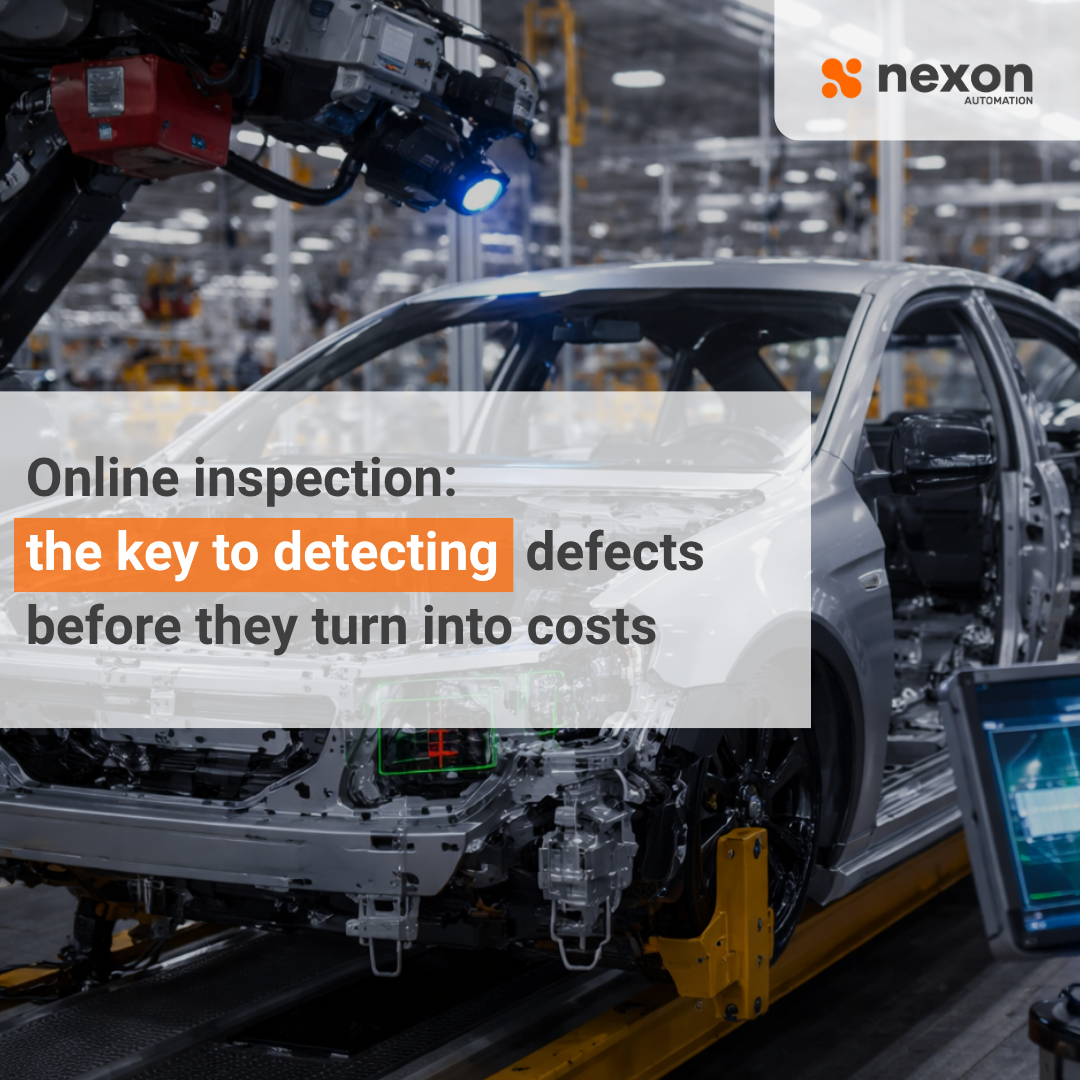
In the automotive manufacturing industry, quality is no longer a differentiator—it is a basic requirement to compete and remain a trusted OEM supplier. For Tier 1 manufacturers, the real challenge is not only producing quality parts, but detecting any deviation at the exact moment it occurs, before it turns into scrap, rework, warranty claims, or customer returns.
In-line inspection, directly integrated into assembly processes, has become a strategic tool to reduce cost of quality, ensure traceability, and strengthen OEM confidence.
The Problem with Detecting Defects Too Late
In many plants, inspection is still concentrated at the end of the process or even outside the production line. This approach creates significant risks:
- Defects are detected at late stages, when added value is already high.
- Rework becomes complex or impossible to execute.
- Scrap directly impacts margins.
- Customer claims, warranties, and hidden costs increase.
- Lack of clear information on where and why the defect occurred.
When in-line inspection and part-level traceability are not in place, problems are discovered when it is already too late—and too expensive.
In-Line Inspection: Changing the Quality Control Mindset
In-line inspection is not about “inspecting more,” but about inspecting better and at the right moment. Integrating inspection directly into assembly stations enables manufacturers to:
- Detect errors at the exact moment they occur.
- Prevent defective parts from moving to the next station.
- Protect downstream processes and the final product.
- Generate reliable data for analysis and continuous improvement.
This approach transforms assembly into a self-controlled, preventive process rather than a reactive one.
What an Intelligent Inspection System Must Validate.
For in-line inspection to be effective and accepted by OEMs, it must address critical aspects of the assembly process:
Presence and absence inspection. Verification that all required components are correctly assembled.
Position and orientation inspection. Confirmation that each component is in the correct position and properly oriented.
Dimensional inspection. Validation of key dimensions and critical tolerances directly in process.
These validations must be automatic, repeatable, and independent of operator judgment.
Traceability as an Essential Complement
In-line inspection delivers real value when combined with serial-number traceability. This allows manufacturers to:
- Associate each inspection result with a specific part.
- Quickly identify affected lots in the event of a claim.
- Reduce the scope of containment and corrective actions.
- Meet OEM requirements and quality audit standards.
Traceability moves beyond being a documentation requirement and becomes a powerful tool for operational control and decision-making.
How Nexon Automation Integrates Inspection and Traceability into Assembly Solutions
At Nexon Automation, inspection and traceability are not treated as standalone systems. They are an integral part of our assembly solutions, designed from the outset to ensure quality at every station.
Integrated machine vision systems
- Cameras and sensors embedded directly into assembly stations.
- Automatic validation of presence, orientation, and dimensional features.
- Process blocking in case of any deviation.
Serial-number traceability
- Automatic recording of results by part and by station.
- Unified association of assembly and inspection data.
- Complete product history.
Integration with plant systems
- Connectivity with MES and SPC systems.
- Support for statistical analysis and continuous improvement.
- Reliable information for production, quality, and engineering teams.
This approach ensures that every part leaving the line is backed by objective quality evidence—not just a final inspection.
Direct benefits of integrated inspection
In-line inspection integrated into assembly delivers clear and measurable results:
- Reduced cost of quality.
- Lower scrap and rework.
- Reduced risk of warranty claims and returns.
- Greater stability during new project launches.
- Strengthened OEM confidence in Tier 1 processes.
- Full visibility into process performance.
Conclusion
Detecting defects at the end of the process is no longer sufficient. In a highly competitive automotive environment, automated in-line inspection integrated into assembly is key to protecting profitability and supplier reputation.
By integrating inspection, traceability, and assembly into a single system, Nexon Automation helps plants transition from reactive quality control to a preventive, robust model aligned with OEM expectations.
Do your assembly processes detect defects on time—or only after they become costs?
At Nexon Automation, we can help you evaluate how to integrate inspection and traceability directly into your assembly stations, with a practical, results-driven approach.
Contact us through our available channels or schedule a technical session with our team to identify concrete improvement opportunities in your production lines.
Fewer failures. Better decisions. Greater profitability. Nexon Automation.
For more information, please contact us at oscar.delgado@nexonautomation.com.
Deja un comentario